
AI narration is changing the economics of audiobooks. Publishers can consider audio editions for shorter works, specialist titles and backlist books that might not justify a traditional studio production. Synthetic speech can also support faster updates or help readers who prefer listening. But a lower production barrier does not automatically grant the right to use a book, imitate a narrator or distribute an audio file.
The key question is not simply “Who owns the voice?” An audiobook combines several assets: the written text, the performance, the voice model or license, the finished recording and the right to distribute it. These assets may be governed by different contracts and laws. The legal position also varies across countries, so publishers should treat this as a rights-management workflow rather than assume that one blanket permission covers every use.
The market is moving faster than contract language
AI narration is already moving beyond prototypes. Amazon Kindle Direct Publishing describes an invite-only beta through which eligible e-books can be turned into audiobooks using its virtual-voice feature. Eligibility and platform terms apply, so publishers should check the current requirements rather than assume every title or language can use the service. [1]
Contract language is evolving too. In April 2026, the Authors Guild announced updated model clauses addressing AI uses including audiobook narration, translation, subsidiary rights and publishers’ use of manuscripts with AI services. The guidance reflects a practical need to define permitted uses clearly instead of relying on general technology clauses. [2]
Separate the five rights questions
First, confirm the rights in the book. A publisher may control print and e-book rights but not audiobook rights in every territory or language. Check the author agreement, any agent-negotiated terms, illustrations or other embedded materials, and the duration and territory of any audio license.
Second, establish permission for a human narrator’s performance. A contract for a conventional recording does not necessarily permit training a model on the narrator’s voice, generating new dialogue or reusing a synthetic replica in unrelated titles. Consent, compensation, duration, revocation and permitted uses should be explicit.
Third, understand the source of the synthetic voice. A licensed text-to-speech voice is different from a model trained to imitate a named person. If a narrator’s own voice is used to create a replica, record what data was supplied, for which purpose, and what future generation or reuse is allowed. Do not assume that a voice provider’s technical license replaces consent from a recognizable individual.
Fourth, define control over the finished recording. The contract should specify who can edit, remaster, distribute, withdraw or license the audio master and any associated files. Fifth, review distributor requirements: platform labels, accepted formats, quality standards, territory restrictions and rights warranties can all affect publication.
What a clear AI narration clause should cover
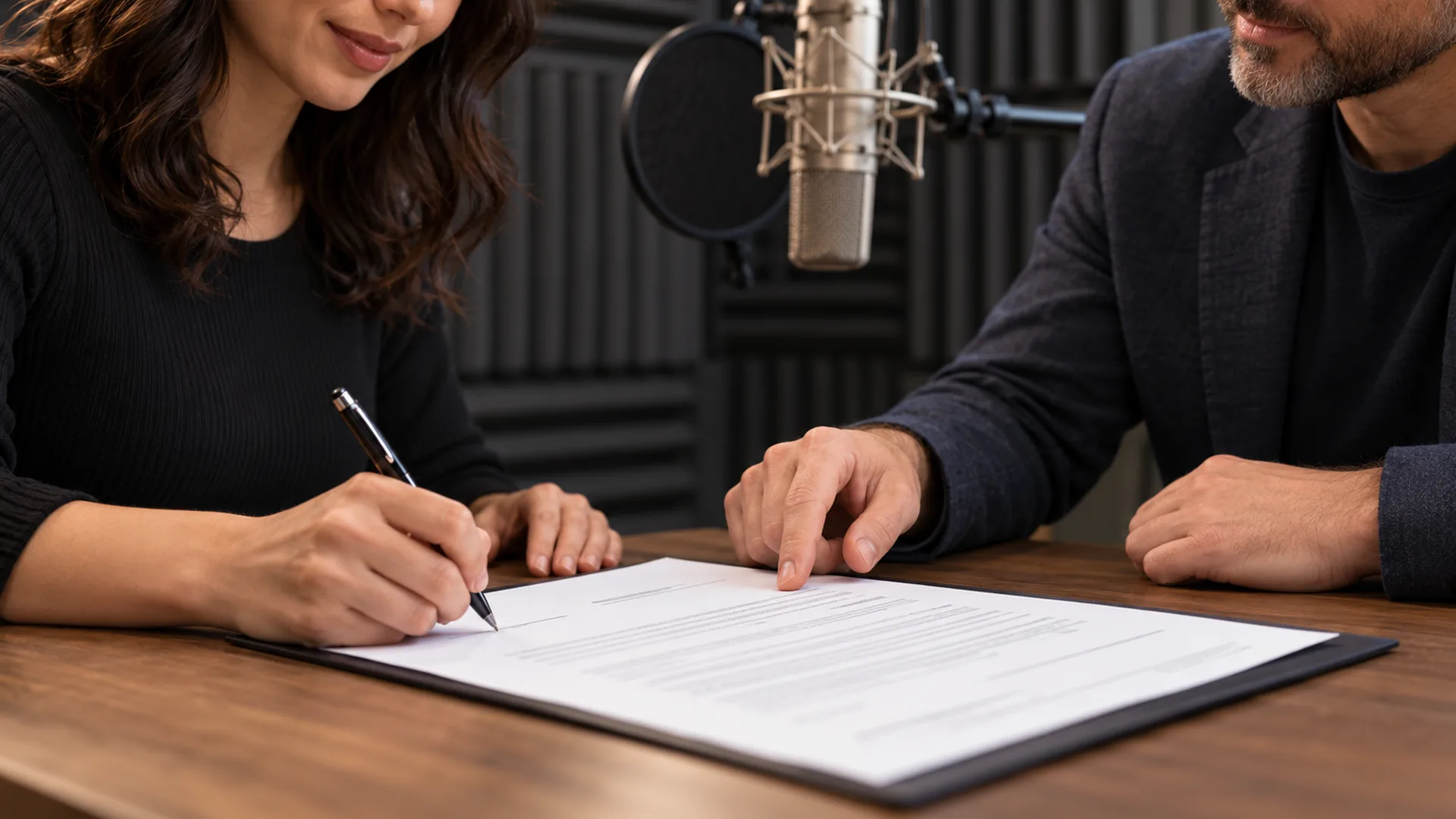
A useful clause says what is permitted in plain language. Does the agreement allow standard synthetic narration, voice cloning, AI translation, excerpts for marketing, or use of the text to train a general-purpose model? These are different uses and should not be bundled together without informed agreement. State the title, editions, languages, territories, duration and platforms covered.
The clause should also address payment, approval and exit conditions. Compensation might be a flat fee, royalty, usage-based license or negotiated combination. The agreement can require review of a sample, a correction process for pronunciation errors, disclosure to listeners and a method to stop future use when the license ends. Broad wording such as “all technologies now known or later developed” may not answer the specific consent questions raised by voice replication.
The U.S. Copyright Office’s report on digital replicas discusses legal gaps around realistic imitations of a person’s voice or likeness and recommends a federal approach; it is a report and set of recommendations, not a universal rule that settles every country’s law. Publishers should seek jurisdiction-specific advice for high-risk projects. [3]
Disclosure and quality are part of the product
Listeners should be able to understand what they are buying. A plain label such as “AI-narrated” can help people choose according to preference, accessibility needs or expectations about performance. Disclosure is also a trust mechanism: it makes the production method visible rather than leaving listeners to discover it through awkward pronunciation or unnatural dialogue.
Regulatory requirements must be checked for the relevant market and type of content. Article 50 of the EU AI Act includes transparency obligations for certain AI-generated or manipulated content, but exact duties depend on the content and circumstances. Publishers should use current European Commission guidance and legal advice rather than assume every audiobook is treated identically. [5]
Quality control remains essential. Test names, acronyms, quotations, code, foreign-language passages and changes in speaker. Review pace, emphasis, chapter transitions and pronunciation. A technically valid audio file can still be a poor listening experience, and a listener may reasonably attribute errors to the publisher even when a third-party voice engine created them.

Practical example: bringing a backlist into audio
Imagine a small educational publisher with 400 older titles. A synthetic-voice service makes it financially possible to produce audio editions for more of the list. This is an illustrative scenario. The publisher first sorts contracts into three groups: clear audio rights, rights needing author clarification, and titles with third-party content or expired permissions.
It pilots ten cleared titles, uses a properly licensed voice, labels the narration, and has an editor review a sample chapter plus a checklist of names, technical terms and citations. The contract specifies voice reuse, distribution rights and what happens when the license expires.
Before expanding, the publisher tracks correction time, listener feedback and returns. This approach treats AI as a production option, not a shortcut around rights clearance.
A practical approval workflow
Before a title enters production, confirm the audio rights in writing, document voice permissions, check the provider’s terms, define the intended markets and agree the disclosure label. Keep evidence of approvals with the title’s rights metadata so later staff can see what has and has not been authorized.
Then create an editorial quality checklist and sample-review stage. Keep the source text and final master linked to the edition record. Where a rights question is uncertain, hold the title rather than assuming silence equals permission. The opportunity in AI narration is not only lower cost: it is making more books available in audio while preserving authors’ choices, performers’ consent and listeners’ trust.
Sources cited and further reading
1. Amazon KDP, “Getting started with audiobooks with virtual voice” ↩
2. The Authors Guild, “Authors Guild Releases New AI Model Clauses and Issues Updates,” April 29, 2026 ↩
3. U.S. Copyright Office, “Copyright and Artificial Intelligence, Part 1: Digital Replicas” ↩
4. SAG-AFTRA, Audiobooks and AI protections
5. European Commission, “Guidelines on transparency obligations for providers and deployers of certain AI systems” ↩